
Explore the Roman Amphitheater at Kom EL Dekka Alexandria

The Roman Amphitheatre in Alexandria is a renowned landmark and the second most significant city in Egypt, following the capital, Cairo. Although Roman arenas were widespread in various countries such as Greece, Italy, and Turkey during the Roman era, with numerous surviving examples in Europe and the Middle East, the Roman Amphitheatre in Alexandria stands as Egypt's sole representation of this architectural marvel.
The Meaning of the Word Kom EL Dekka
Kom El Dekka, derived from Arabic, translates to "the hill of rubble" or "the hill of the benches." It was named by an esteemed historian named El Neweiry, who visited the area in the early 20th century. El Neweiry observed numerous mounds of rubble and sand that had accumulated during the excavation of the Mahmoudiya Canal in the late 19th century. This canal connected Alexandria to the River Nile. The heaps of debris resembled large benches, and El Neweiry bestowed the area with its well-known name.
Discovering the Roman Amphitheatre
In 1960, the Roman Amphitheatre of Alexandria was unexpectedly found through a stroke of luck.
When the workers removed a pile of dust and sand in 1960 to clear the land for the construction of a governmental building, they found some solid iron columns, indicating that something may be buried underneath. Immediately afterward, the excavation work began in the location of Kom El Dekka, and it was carried out by the Greco-Roman Museum and the Polish Excavation Mission in Egypt, sponsored by the University of Warsaw.
The Usage of the Roman Amphitheatre in Different Periods of Time.
The Roman Amphitheatre remained used for various artistic events, including musical concerts, until the 7th century. This is evident from the architectural features found in the theater, which indicate its use during the Roman, Byzantine, and Early Islamic periods. Throughout its extensive history, the theater served multiple purposes. During the Roman era, it was an odeum for musical performances, equipped with a dome and an orchestra section. In the Byzantine period, it was a conference hall for important meetings such as public assemblies and governmental summits. However, the Roman Amphitheatre was likely neglected during the early Islamic period until its rediscovery in the mid-20th century, when it became a remarkable historical site in Alexandria.
The Description of the Amphitheatre
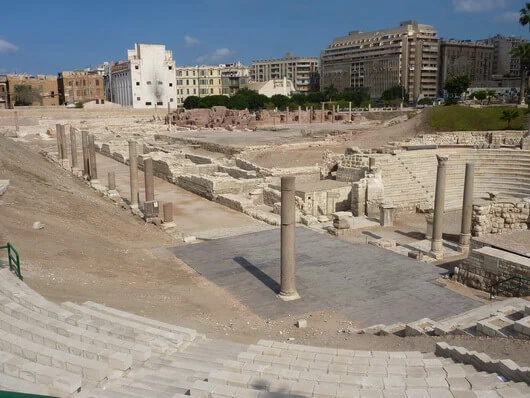
The Roman amphitheater in Alexandria, which we observe today, was built in the 4th century AD and is a typical Greco-Roman structure. These amphitheaters, specially designed with roofs, were used for hosting musical events and poetry competitions during Roman rule in Egypt.
The arena, capable of accommodating up to 600 spectators, showcases a symmetrical marble audience section with an extended wing. The diameter of the audience section measures approximately 33 meters. Constructed with European white marble, it consists of 13 rows. The uppermost part of the section serves as an entrance, featuring granite columns imported from Aswan, some of which remain intact today. The seating arrangement in the Roman Amphitheatre of Alexandria was organized using Roman numerals and letters. At the top of the audience section were five compartments reserved for essential individuals and wealthy traders during performances. Initially, these compartments had domed ceilings supported by large granite columns, protecting them from the sun and rain. Additionally, these domes amplified the sounds of music and chants during various performances. Unfortunately, an earthquake in the 6th century AD destroyed these structures and other significant landmarks, such as the Pharaoh's Light House, which once stood in the present-day Qaitbey Fort.
A thick white limestone wall supports the steps and rows of the Roman Amphitheatre, and another wall surrounds it. These two walls were connected through several arches, with the outer wall serving to keep the inner wall, a common feature of Roman architecture from the 2nd to the 4th century.
In the middle of the structure is the orchestra section where the musical performances used to take place. Two large marble columns support this section, with some of the finest Roman mosaics on its floor.
Comparing the Roman Amphitheatre with other similar structures
Contemporary researchers who have compared the Roman Amphitheatre of Alexandria with similar structures discovered in Italy, Greece, and the Theatre of Garash in Tunisia have concluded many exciting facts. The first fact that these researchers proved is that the Roman Amphitheatre of Alexandria was not originally constructed to be a theatre hosting performances and artistic events.
This type of theatre was usually designed in the shape of a "C" to allow all the spectators around the audience section to watch the performances from any angle.
Moreover, the size of the structure, which used to host up to 600 people at a maximum, compared with the large number of inhabitants of Alexandria during the Roman period, proves that this structure was never constructed to be a theatre. It was instead used for meetings of essential figures and officials or private performances with a limited audience.
The Villa of the Birds and the Roman Baths
To the North of the Roman theatre lies a collection of large mud brick structures, which are the remains of the Roman baths built near the arena between the 2nd and 4th centuries AD. Near the East of the Roman Amphitheatre of Alexandria, recent archaeological missions have uncovered a Roman villa from the Roman Emperor Hadrian, who ruled Egypt and a vast empire during the 2nd century AD. The archaeologists who found this villa named it "the Villa of the Birds" due to the exquisite mosaic floor in its main room, featuring various bird designs. The Villa of the Birds also boasts other mosaic decorations with geometric patterns, making it a unique and noteworthy site in Egypt. Considered the most beautiful example of a private residence from the Roman era in Alexandria, the well-preserved state of the villa offers visitors a glimpse into its original appearance centuries ago. Under the protection of the Egyptian Supreme Council of Antiquities and the American Research Center in Egypt, the Villa of the Birds is one of Egypt's most significant recent discoveries.


