
The Pyramids of Dahshour
The Pyramids of Dahshour encapsulate ancient Egypt. Although places like the Giza Plateau are more excellent tourist sites, Dahshour is similar to a great book, telling us tremendous and glorious stories of Ancient Egyptian History.
Dahshour is one of Memphis's most essential cemeteries and one of many vast necropoleis in the great Ancient Egypt Capital. Located about 30 Km south of the pyramids of Giza and in the southern wing of Saqqara, the Dahshour area contains pyramids of the IV and the XII Dynasties. Here, you will find the Pyramid of Amenemhat II, the Pyramid of Amenemhat III, or the Black Pyramid. The great King Snefru (2680-2656 B.C), the founder of the IV Dynasty, was the first king to build his tomb in this royal area, as it was close to the capital, Memphis.
The Bent Pyramid

First, he built the Southern Pyramid, or what we call today the Bent Pyramid. The architect was horrified to find he had made a mistake during its construction, and he only realized it once the pyramid's height reached about 48m (with an angle of 54 degrees)! He made a quick decision and altered his design to make it safer (and to prevent what had happened at Medium). When he finished, the pyramid's angle was just 43 degrees! Today, it is called the Rhomboid or Bent Pyramid. Egyptologists, analyzing why he made the change, think that the angle of 54 degrees would result in a very unsafe but huge and high pyramid. This would have made the pyramid very unstable, especially when cracks started to appear, which they did and were later filled with gypsum.
The Southern (Bent) Pyramid of Dashur was built from local limestone and cased in fine Turah limestone. Its height is about 101m, with a length of 188.6m on each side. The pyramid's original entrance is found on the northern face as usual, but Professor Ahmed Fakhry (1905–1973), during his 1951 excavations, discovered another unknown door on its western side.
One of the pyramid's most remarkable features is cedar beams, which are thought to have been imported from Lebanon. East of the pyramid is a small Mortuary Temple with a tiny shrine. To the south is a small subsidiary pyramid, cleared in 1947 by the Egyptologist Abd El-Salam Hussein.
The Red Pyramid
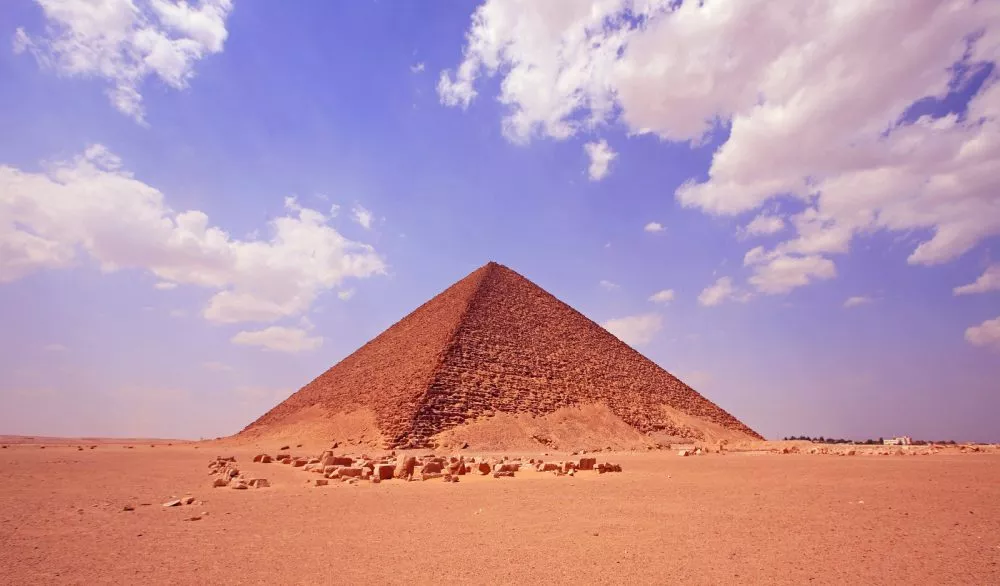
About 2 km to the north of the southern Pyramid, another pyramid was built for King Snefru. This time, his architect was more careful. He avoided all his previous mistakes by following the same angle from bottom to top - 43 degrees. This helped to create the first perfect, complete Pyramid in history. This became the "blueprint" for all future Pyramids, which appeared during the IV, V, and VI dynasties. This "perfect
pyramid" is known as the Northern Pyramid due to its location and Red Pyramid, as the builders favored a special kind of rosette limestone to build the inner burial chamber. It is 99m high, and each side of the base is 220m in length.
The entrance lies 28m above the ground on the Pyramid's northern face. A steep, 60 m-long passage leads down to the first chamber, which connects to the second chamber by a low, rectangular passageway. These chambers are about the same size, with high walls and a corbelled ceiling. At the far end of the second chamber is the entrance to the burial chamber; a wooden ladder takes you up to the door, about 8m above the floor level, and a wooden bridge spans the burial chamber itself. About 16m above you is the high, corbelled ceiling(supported by an arch) Helpful Tip – bring a flashlight as the illumination is feeble.
On the eastern side of the Pyramid is the Mortuary Temple of King Snefru. Though ruined, you can still see how it was once laid out, and you can also see some of the original fines, Turah limestone casing stones. Plus, situated here is what is thought to have been the capstone of the Pyramid, though there is much dispute to that fact, as the slope angle is different from that of the Pyramid.
Other Pyramids near the area (The Black pyramid)
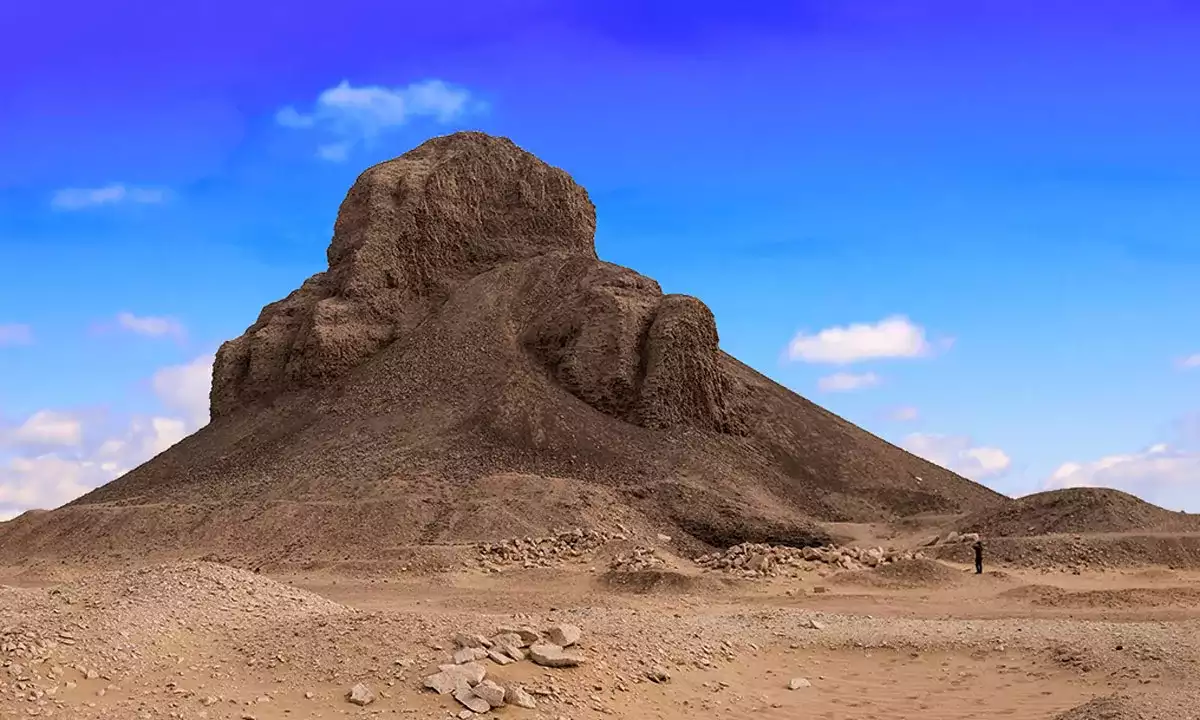
The cemetery of Dahshour contains other pyramids, smaller in scale, built out of mud bricks, and dating back to the XII Dynasty. These belonged to Amenemhat II, Senusert III, and Amenemhat III. Inside the Pyramid of King Senusert III, a precious collection of jewels and gold was found, which is now found globally at select museum locations. Specifically, the group that belonged to some of the Princesses of the XII Dynasty.
Many tombs were uncovered in the area of the pyramids but were either in bad condition or never completed.


